Turn Thermal Challenges Into Performance Advantages
From overheating batteries to inefficient cooling systems, we transform thermal constraints into competitive advantages through advanced simulation and innovative solutions.
Thermal limits kill performance. Overheating shortens battery life, throttles processors, reduces solar efficiency, and constrains design. But thermal management done right unlocks 20-30% performance gains, extends product lifetime, and cuts energy costs dramatically. We solve thermal problems with deep physics understanding, advanced simulation tools, and innovative cooling strategies, delivering validated solutions that work in the real world, not just in reports.
Schedule a 15-30 minute conversation. Discover what thermal optimization can do for your product.
Thermal Challenges That Limit Performance
And How We Solve Them
You’re designing a system where thermal behavior determines success or failure. Maybe your EV batteries overheat during fast charging. Your data center hits thermal limits and throttles performance. Your solar thermal system underperforms. Or perhaps thermal constraints force you to compromise on weight, size, or power. Whatever the challenge, thermal optimization isn’t optional, it’s your competitive advantage. We combine deep thermal physics understanding with advanced simulation to unlock performance others can’t achieve.
Battery Thermal Management
EV battery pack thermal design
Fast-charging thermal strategy
Thermal runaway prevention and safety analysis
Battery Management System (BMS) thermal integration
Second-life battery thermal characterization
Thermal testing strategy and validation
Why it matters: Battery life, safety, and fast-charging capability all depend on thermal management. Poor thermal design = reduced range, warranty failures, and safety risks. Proper thermal optimization = 20% longer battery life and safe fast-charging.
Aerospace Propulsion
Engine thermal management
Avionics and electronics cooling in harsh environments
High-altitude and extreme-temperature thermal behavior
- Thermal management in space
Lightweight thermal insulation and heat shielding
Cabin environmental control and thermal comfort
Why it matters: Aerospace thermal challenges are unforgiving—altitude, speed, and temperature extremes demand precision. Our aerospace heritage means we understand that “good enough” isn’t good enough.
Data Center & HPC
AI processor thermal management
Liquid cooling system design (direct-to-chip, immersion)
Two-phase cooling optimization for maximum efficiency
Hybrid air-liquid cooling strategies
Energy-efficient cooling architecture
Why it matters: AI workloads generate extreme heat. Traditional air cooling hits physical limits at 70 kW/rack. Advanced liquid cooling can handle 200+ kW/rack while cutting energy costs 30-40%.
Solar Thermal & Renewable
Solar thermal collector efficiency optimization
Photovoltaic panel temperature management (every 1°C = 0.5% efficiency loss)
Concentrated Solar Power (CSP) receiver thermal design
Thermal energy storage system optimization
Heat recovery and waste heat utilization
Seasonal thermal storage modeling
Why it matters: Solar thermal efficiency directly drives ROI. Proper thermal design = 15-25% yield improvement, faster payback, and better grid integration.
Advanced Materials & Thermal Property Characterization
Composite and textile laminate thermal conductivity measurement
Radiative property characterization
Phase-change material (PCM) thermal modeling
Anisotropic material thermal behavior
High-temperature material thermal validation
Why it matters: Accurate material properties are the foundation of reliable thermal predictions. Generic database values = massive errors. Measured properties = confidence in your thermal design.
Multi-Physics Thermal Integration
Aero-thermal coupling (airflow + heat transfer)
Thermo-structural analysis (thermal stress, thermal expansion)
Electro-thermal simulation (Joule heating, power electronics)
Radiation-convection-conduction coupled problems
System-level thermal architecture
Why it matters: Real thermal problems don’t exist in isolation. Ignoring coupling results in wrong answers. Multi-physics modeling gives accurate predictions and optimized systems.
Our Three-Phase Approach
Every project is different. Some start with a well-defined problem, others need clarification first. Our process is flexible, but always follows the same principle: understand deeply, analyze rigorously, deliver actionable results.
1. Rapid Assessment
What Happens:
Thermal problem scoping and constraint identification
Hand-calculation thermal estimates
Feasibility analysis and thermal margin assessment
Tool and method selection
Quick-win identification
Deliverable: Thermal assessment report with problem summary, thermal estimates, recommended approach, and feasibility analysis.
Timeline: 5-10 working days
Why Start Here? Many thermal problems can be solved or scoped analytically in days. You get fast answers, identify quick wins, and decide if detailed simulation is justified. Low cost, high value.
2. Simulation & Optimization
What Happens:
High-fidelity thermal model development (geometry, materials, boundaries)
Multi-physics simulation (conduction, convection, radiation, coupled)
Parametric studies and thermal optimization
Design iteration and trade-off analysis
Thermal margin verification and sensitivity analysis
Deliverable: Comprehensive thermal analysis report with methodology, simulation results, thermal maps, design recommendations, and test validation roadmap.
Timeline: 1-6 months typically, up to 1 year
Why Phase 2 Matters: This is where thermal innovation happens. Where advanced simulation reveals non-intuitive solutions. Where you discover the 20-30% performance gain hiding in your thermal design.
3. Validation
What Happens:
Thermal test planning (thermocouples, IR imaging, chamber testing)
Test-to-simulation correlation and model calibration
Design iteration based on test results
Thermal certification documentation
Production thermal troubleshooting
Deliverable: Validated thermal designs, test correlation reports, thermal compliance documentation, design inputs to manufacturing.
Timeline: As needed (ongoing)
Why This Phase: Simulation without validation is never certainty. We close the loop, proving your thermal design works in reality, not just in software.
Tools & Expertise
We’re tool-agnostic thermal problem-solvers. We choose the best simulation approach for your specific challenge, from analytical methods to cutting-edge multi-physics CFD. Here’s our thermal engineering arsenal from open source to commercial software that we employ on demand:
TAITherm
Industry-leading thermal analysis platform for aerospace and automotive, transient radiation, solar loads, complex view factors
SimScale
Cloud-based thermal simulation for rapid iteration, collaboration, and parametric studies
OpenFOAM/ ANSYS Fluent/ STAR-CCM+/ COMSOL Multiphysics
Coupling CFD with thermal analysis tools to account for all heat transfer modes.
Ansys Icepak
Electronics Cooling & PCB Thermal Simulation and Analysis
Custom Scripts
MATLAB/Python thermal scripts for hand calculations, optimization, parametric studies, and automation
CAD Integration
CATIA , Salome, and CAD-to-thermal workflows
Technical Capabilities
Conduction Analysis — Steady-state and transient heat transfer in solids, composites, layered structures, anisotropic materials
Convection Modeling — Natural and forced convection in enclosures, channels, complex geometries; turbulence modeling (RANS, LES)
Radiation Heat Transfer — Solar loads, infrared exchange, view factor calculation, participating media, high-temperature radiation
Conjugate Heat Transfer — Coupled fluid-solid thermal analysis with interface heat transfer
Phase Change Modeling — Melting, solidification, sublimation; phase-change materials (PCM) for thermal storage
Multi-Physics Coupling — Aero-thermal, thermo-structural, electro-thermal, fluid-structure-thermal interaction
Thermal Comfort Analysis — PMV/PPD metrics, thermal comfort zones, HVAC performance
Battery Thermal Modeling — Cell-level and pack-level thermal behavior, thermal runaway simulation, cooling strategy optimization
Material Property Testing — Thermal conductivity, specific heat, emissivity/absorptivity measurement; inverse modeling
Thermal Optimization — Multi-objective optimization (minimize temperature, minimize weight, maximize efficiency)
Test Correlation & Validation — Thermocouple data analysis, IR thermography correlation, thermal test planning
Certification Support — Thermal analysis documentation for FAA, EASA, automotive standards, battery safety standards
Why Choose Privilege Aircrafts
Most thermal consultants run software. We solve thermal problems. 15+ years of aerospace thermal experience means we understand the physics deeply, recognize non-intuitive solutions, and deliver validated results, not just colorful temperature plots.
Deep Thermal Physics Understanding & Innovative Solutions
We don't just model heat transfer—we understand thermal physics at a fundamental level. Aerospace thermal challenges (re-entry heating, solar radiation at altitude, cryogenic fuels, extreme temperature gradients) demand deep understanding. That expertise translates to innovative solutions for your thermal problems: novel cooling strategies, lightweight thermal management, and multi-physics optimization that generic thermal consultants miss. You get solutions that work, not just simulation reports.
Proven Track Record Solving Complicated Thermal Problems
We've solved thermal challenges others could not: helium airship thermal management (where convection fails and radiation dominates), unconventional nacelle cooling with extreme weight constraints, solar-loaded textile structures. We've led thermal team for French Tech Next-40 company and contributed thermal analysis to major aerospace programs (Airbus, Sabena Technics Flying Whales). Our thermal recommendations don't just look good on paper, they enable product launches and certifications.
Fast, Flexible, Senior Expertise
Small firm translates to fast decisions. No procurement bureaucracy. No hand-offs to junior engineers. You work directly with a senior thermal engineer (15+ years aerospace and R&D) who understands your constraints: cost, time, safety, certification. We deliver rapid assessments in days, detailed studies in weeks-to-months. And we don't sacrifice rigor for speed. We deliver aerospace-grade precision with startup agility.
Real Thermal Challenges, Innovative Solutions, Proven Results

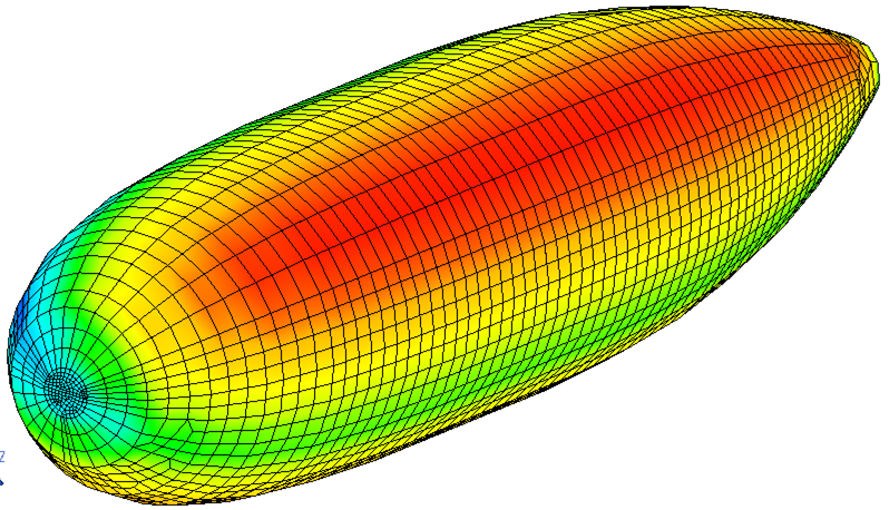
Helium Airship Thermal Management
Client: Flying Whales (French Tech Next 40)
The Challenge
Design efficient ventilation and thermal management for a large helium-filled cargo airship operating under extreme solar radiation. This wasn’t a conventional aerospace thermal problem—it required fundamentally new thermal thinking:
Variable low speeds (0-70 km/h) — Convective cooling unreliable
Massive solar loads — 25,000+ m² envelope exposed to radiation
Heat-sensitive textiles — Technical fabrics with strict temperature limits
Helium expansion behavior — Helium expands differently than surrounding air, creating structural loads; precise temperature estimates crucial for structural integrity and buoyancy control
Lightweight constraints — Every kilogram of thermal insulation reduces payload capacity
Our Approach
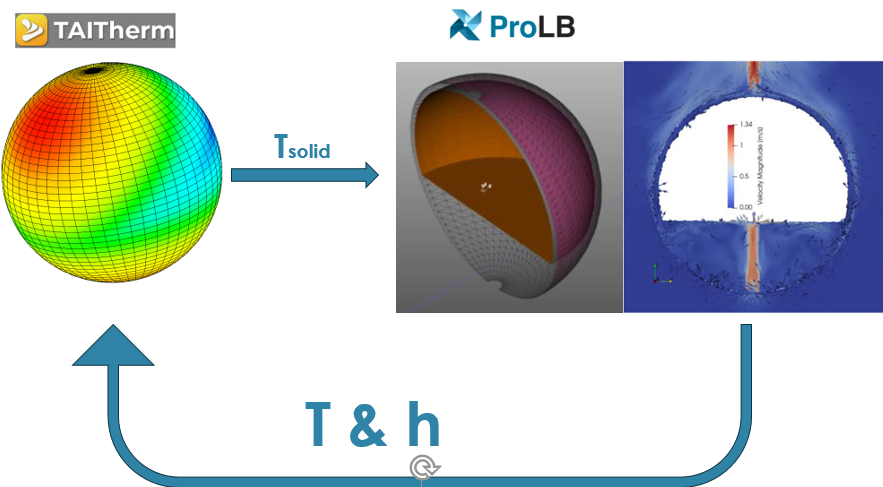
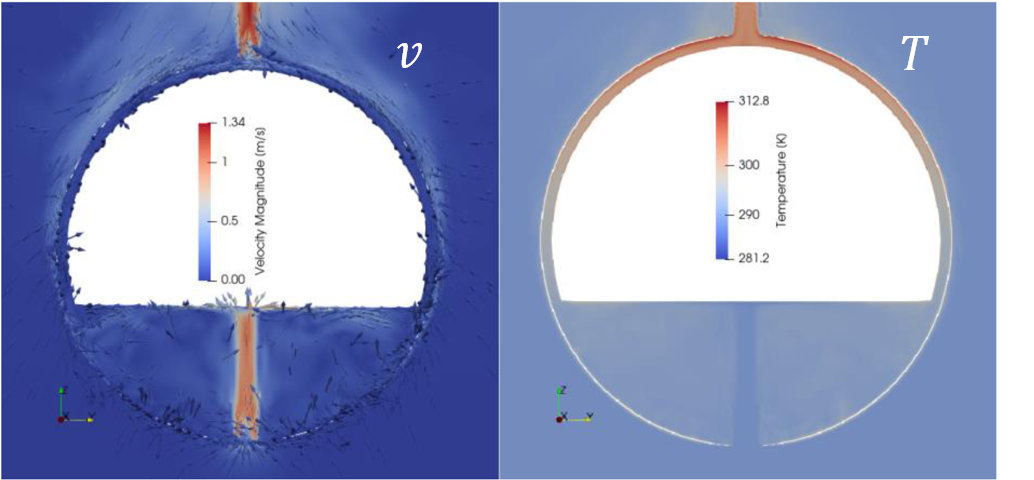
Advanced thermal modeling — TAITherm coupled with ProLB simulations on AWS; high-fidelity solar radiation model
Material characterization — Analyzed envelope and cell materials to identify optimal radiative properties (absorption, reflection, transparency) for thermal performance
Airship thermal behavior modeling — Performed high-fidelity simulation studies to predict thermal behavior across diverse mission conditions
Flight simulator integration — Contributed validated thermal models to flight simulator for pilot training and certification, accounting for day/night thermal cycles and operational conditions
Results
✓ First accurate thermal model for large helium airships — Predictions within 0.5°C of test data
✓ Structural safety enabled — Precise helium expansion predictions prevents cells overstress
✓ Material selection and optimization — Identified optimal envelope and cell materials balancing thermal performance with cost-effectiveness and operational requirements
Key takeaway: This required deep radiation physics understanding, helium thermal behavior modeling, custom textile characterization, and aero-thermal coupling at variable speeds. If we can solve this unconventional challenge, we can solve yours.
Schedule a 15-30 minute conversation. Discover what thermal optimization can do for your product.
 English